
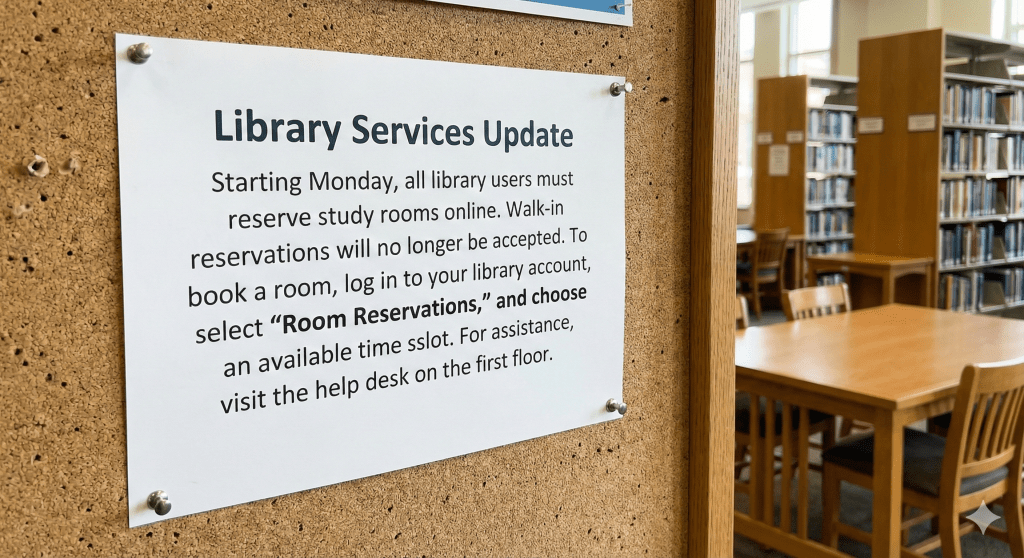
The Read in Daily Life task is a new task type introduced in the updated TOEFL iBT. It reflects the test’s shift toward measuring practical, real-world English skills rather than only academic reading. This task evaluates how well test takers can understand short, everyday texts that people commonly read outside of classrooms, such as notices, emails, and advertisements.
Because this task is new, many students are unfamiliar with its format and expectations. However, with the right strategies, Read in Daily Life can be one of the easiest ways to gain points in the Reading section.
What Is the Read in Daily Life Task?
In this task, test takers read short non-academic texts (about 15–150 words) taken from daily situations. Each text is followed by two or three multiple-choice questions, depending on the length of the passage.
Common Text Types Include:
- Notices, signs, or posters
- Emails or chains of text messages
- Advertisements and announcements
- Menus and schedules
- Forms, invoices, and receipts
- Social media posts or web pages
- Short news articles
These texts are designed to reflect real-life reading experiences, not university-level materials.
Skills Assessed in Read in Daily Life
This task measures your ability to:
- Understand information in common, nonlinear formats
- Identify the main purpose of a message
- Understand informal and semi-formal language
- Recognize common idiomatic expressions
- Make simple inferences based on context
- Interpret telegraphic language (short, direct phrases)
- Skim and scan efficiently for key details
Typical Question Types
Questions may ask you to:
- Identify who issued the notice
- Understand why the message was written
- Decide what action the reader should take
- Locate specific details such as dates, prices, or instructions
- Make basic inferences about meaning or intention
The questions are usually direct, but success depends on speed and focus.
Best Approaches to Succeed in Read in Daily Life
1. Read With a Purpose
Start by quickly scanning the text to identify:
- Who is the sender?
- Who is the audience?
- What is the goal of the message?
This prevents unnecessary rereading and helps you focus on what matters.
2. Focus on Function, Not Vocabulary
You do not need to understand every word to answer correctly.
- Pay attention to headings, bold text, and lists
- Focus on actions, instructions, and key facts
- Use context to guess unfamiliar words
In daily-life texts, meaning is usually obvious from structure.
3. Watch for Imperatives and Instructions
Many texts include command verbs such as:
- Sign up, Enroll, Submit, Access, Select
These words often signal the main purpose of the message.
4. Understand Common Idiomatic and Informal Language
You may see phrases like:
- Sign up today
- Limited time offer
- Paperless billing
- Upper right-hand corner
These expressions are common in everyday English and rarely have hidden meanings.
5. Use Elimination Strategically
If you are unsure:
- Eliminate answers that do not match the source of the text
- Remove options that add information not mentioned
- Choose the answer that best fits the overall purpose
This method is especially effective in business or notice-related questions.
6. Practice With Real-World Materials
To prepare effectively:
- Read real emails, ads, menus, and notices
- Practice scanning for specific information
- Answer questions under time pressure
This builds both speed and confidence.
Common Mistakes to Avoid
- Overanalyzing simple texts
Many students treat these passages like academic readings. This leads to confusion and wasted time. The correct answer is usually direct and clearly stated. - Translating word by word
Trying to mentally translate every word slows you down and increases anxiety. Focus on meaning, not perfect understanding. - Ignoring titles or headings
Titles often reveal the main purpose of the text. Skipping them can cause you to misunderstand the entire message. - Missing instructions hidden in short phrases
Important information is often expressed briefly (e.g., “Select account preferences”). Skimming too fast can cause you to miss these critical details.
Sample Questions
Read a Notice
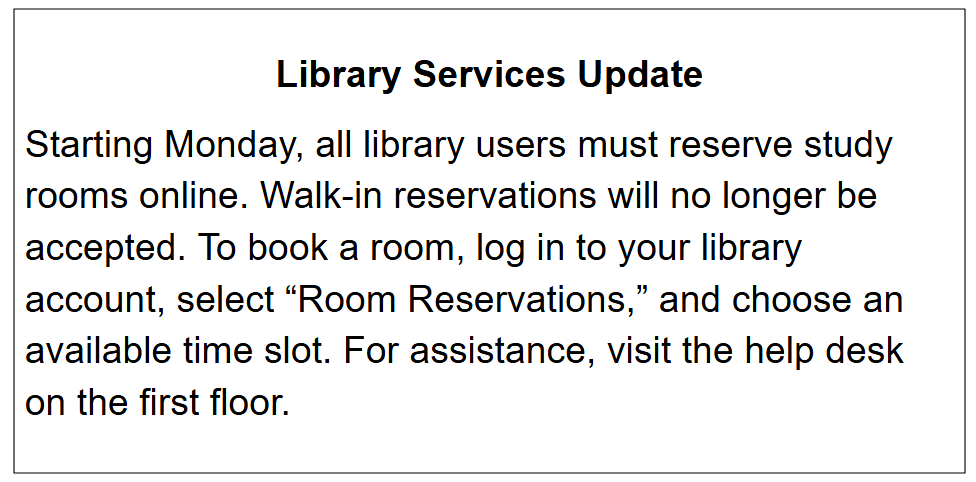
1. What is the main purpose of this notice?
A. To explain how to create a library account
B. To announce a change in study room reservations
C. To advertise new library services
D. To describe library opening hours
2. What should users do to reserve a study room?
A. Visit the help desk
B. Make a walk-in reservation
C. Reserve the room online
D. Call the library office
 English with Arik
Leave a comment