

When students take the TOEFL iBT, they are not all answering the exact same Reading and Listening questions. Instead, TOEFL uses a smart system called Multistage Adaptive Testing (MST) to better match test difficulty to each test taker’s ability. This approach makes the test more efficient, fair, and accurate.
What Is Multistage Adaptive Testing (MST)?
Multistage Adaptive Testing is a hybrid between:
- Traditional linear tests (everyone sees the same questions), and
- Fully adaptive tests (difficulty changes after every question).
In MST, adaptation happens at the module level, not question by question. This allows TOEFL to:
- Maintain strong control over test content
- Include realistic academic tasks
- Accurately measure proficiency across a wide ability range
The Two-Stage Design in Reading and Listening
Both Reading and Listening sections follow the same two-stage structure:
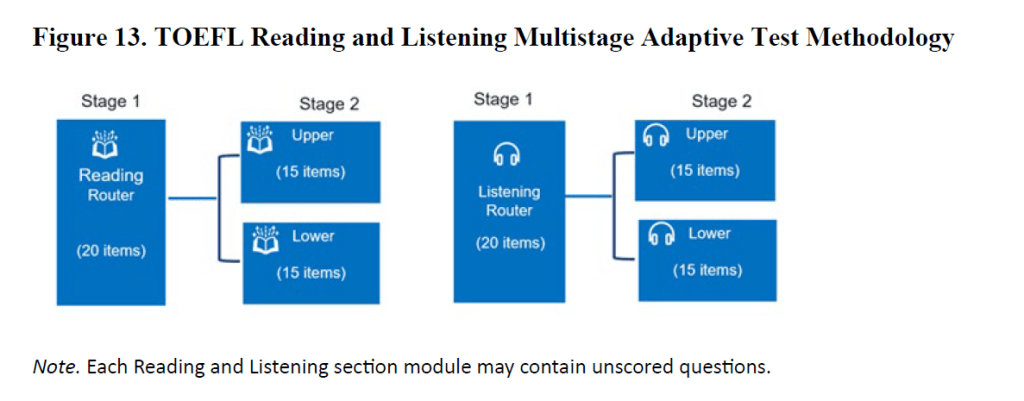
Stage 1: Router Module
- Everyone starts here
- Contains moderate-difficulty questions (roughly CEFR B1–B2)
- Used to estimate the test taker’s ability level
- May include unscored questions for quality control
Stage 2: Difficulty-Based Module
Based on performance in the router module, the test routes the student to:
- Lower-difficulty module, or
- Upper-difficulty module
Each test taker completes one path only:
- Router → Lower
- Router → Upper
This is what makes TOEFL adaptive, but in a controlled and predictable way.
Why Routing Matters for Scoring
TOEFL scoring does not simply count correct answers. It also considers:
- The total number of correct responses
- The difficulty level of the modules completed
This means:
- Answering many questions correctly in a harder (upper) module carries more weight
- Two students with the same raw score may receive different scaled scores depending on their path
This design improves score accuracy without making the test feel unpredictable or stressful.
Reading Section: Content Design
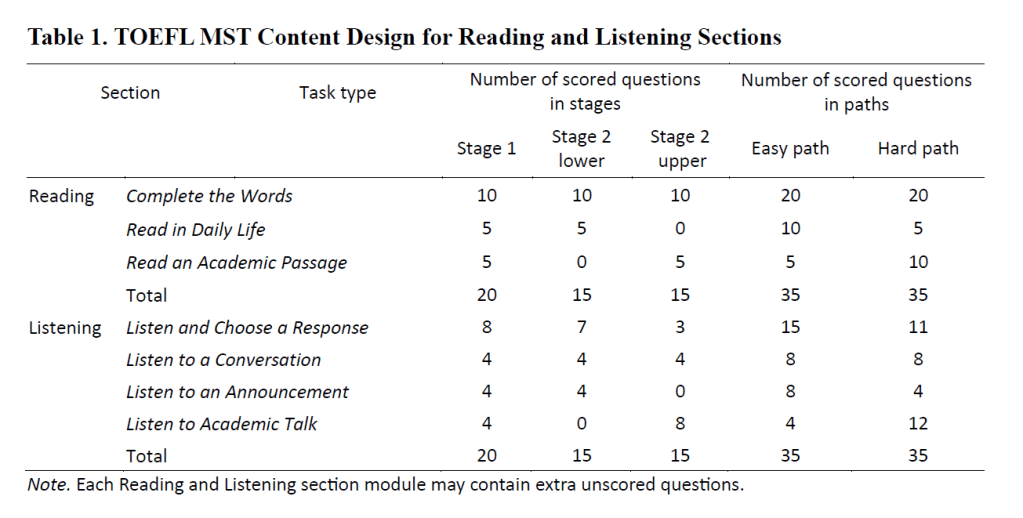
Each Reading section includes tasks such as:
- Complete the Words
- Read in Daily Life
- Read an Academic Passage
Structure:
- Router module: 20 scored questions
- Second stage (Lower or Upper): 15 scored questions
- Total per path: 35 scored questions
The balance of task types changes slightly depending on the difficulty path, ensuring appropriate challenge at each level.
Listening Section: Content Design
Listening tasks include:
- Listen and Choose a Response
- Listen to a Conversation
- Listen to an Announcement
- Listen to an Academic Talk
Structure mirrors Reading:
- Router module: 20 scored questions
- Second stage (Lower or Upper): 15 scored questions
- Total per path: 35 scored questions
Again, task difficulty and distribution adjust based on the routed module.
What About Writing and Speaking?
Unlike Reading and Listening, Writing and Speaking are linear:
- All test takers receive the same tasks
- No routing or adaptive modules
- Scores are based on overall performance across tasks
Writing Tasks
- Build a Sentence
- Write an Email
- Write for an Academic Discussion
Speaking Tasks
- Listen and Repeat
- Take an Interview
This ensures consistency and fairness in productive skills that require human or AI scoring.
Why TOEFL Chose MST
ETS selected the MST design because it:
- Balances measurement accuracy and practicality
- Allows expert review of entire modules before use
- Preserves TOEFL’s task-based, communicative approach
- Manages question pools more effectively than question-by-question adaptation
In short, MST allows TOEFL to be adaptive without sacrificing quality or realism.
What This Means for Test Takers
✔ You are not penalized for getting harder questions
✔ The test adapts to better reflect your real ability
✔ You don’t need separate “advanced” or “basic” versions
✔ Strong performance early can unlock higher-value questions
The best strategy remains simple: do your best on every question, especially in the first module.
 English with Arik
Leave a comment